Our sustainability journey - Plasmor
Showing results for ( results)

Our sustainability journey

We’re committed to a greener and more sustainable future and we’re working hard to get there. We’ve already made some big steps in our sustainability journey, and we’re excited to take the next ones…

What do we mean by sustainability?

Sustainability is the greatest challenge facing the architectural, building and building supply industries at the moment.

In the construction sector, sustainability is the commitment to plan, design, procure, build, operate and decommission assets in a way that protects the environment, supports people and communities, and delivers long-term economic value.

Considering both operational and embodied carbon, the built environment is responsible for around 40% of global greenhouse gas emissions. The sector carries a responsibility to decarbonise and to transition to resource-efficient, low-impact solutions.

Adobestock 556470854
Our journey to improve carbon reduction...
18 %
of our finished product is distributed by rail every day, taking approximately 50 LGVs off the roads.
28 %
As a result of the installation of 1311 no. solar panels in January, we will reduce our electrical consumption at Knottingley from the grid by a staggering 28%.
76 %
By using diesel-powered locomotives, it generates up to 76% lower carbon emissions than that of road transport.
90 %
Total recycled content in our Low Carbon Synerg.Eco range.

FAQs

Sustainability

Embodied carbon emissions are the total CO₂ emissions associated with a building material's lifecycle—from raw material extraction (cradle) to disposal or reuse (grave). For masonry units, this includes quarrying, manufacturing, transport, construction, demolition, and potential recycling, often measured via an Environmental Product Declaration (EPD).

  1. Lower our operational emissions by incorporating solar panels, heat pumps, green electricity, and rainwater harvesting systems
  2. Exploring alternative fuel options for vehicle operations, including those used for deliveries and on-site transportation
  3. Reducing reliance on fossil fuels to the greatest extent feasible.
  4. Introduction of high performance re-cycled assured aggregates
  5. Ongoing evaluation of all components of the concrete mix to ensure it is as environmentally sustainable as possible
  6. Creation of new low carbon products such as our ‘Synerg.Eco’ range.

Synerg.Eco satisfies sustainability and environmental credentials where specified, whilst complying with thermal and acoustic building regulations.

Mortar - Typically M4 mortar would be used above DPC, below DPC would be suited to the local ground conditions and assessed independently

Fire Rating - Synerg.Eco is A1 (non-combustible) classification as defined in BS EN 13501-1

Thermal Conductivity  (at 3% moisture) k = 0.41W/m.K for 7.3N/mm2 Synerg. blocks are Part L compliant

Sound Insulation - Synerg.Eco Paint Grade  blocks comply with Part E and Robust Details for floors and walls

Available in both Standard and Paintgrade finishes with a strength of 7.3 N/mm², the Synerg.Eco is suitable for both domestic and commercial applications. Ideal for use as infill in framed constructions, party walls, beam and block floors, the inner leaf of cavity walls, and externally where render is applied. With a density of 1400 kg/m³, it offers versatile performance across a wide range of construction scenarios.

Yes, they are verified by the EPD Hub https://manage.epdhub.com/


While the lifecycle of an aggregate block is assessed at 60 years within an Environmental Product Declaration (EPD), in practice, blocks can exceed 150 years of service life when properly constructed. Masonry remains a durable, long-term building solution designed to stand the test of time."

Synerg.Eco is currently the lowest-carbon lightweight block of its kind delivered into London. Manufactured using CEM I 52.5N cement and made from 100% recycled or secondary processed aggregates—with a total recycled content of 90%—it delivers high performance with a low environmental footprint.

A Life Cycle Assessment (LCA) is a methodology used to evaluate the environmental impact of a product throughout its entire life cycle, from raw material extraction to production, use, and eventual disposal / reuse.
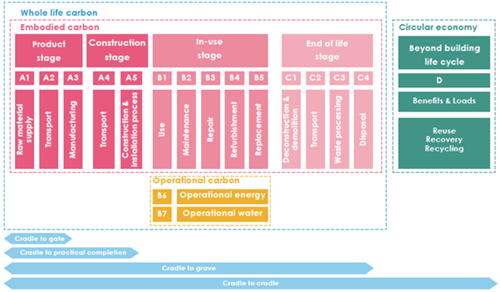
Image credit: https://www.greengage-env.com/life-cycle-assessment/

A1–A3: Product Stage, also known as ‘Cradle to Gate’ (Including raw material supply, transport and manufacturing)

A4–A5: Construction Process Stage (Including transport to site & installation)

B1–B7: Use Stage (including use, maintenance, repair and replacement)

C1–C4: End-of-Life Stage (Including demolition, transport, waste processing, disposal)